When water tanks freeze, there’s often no air below the ice to cushion against water hammer
What’s really causing main breaks?
A sudden pressure change in a water system can create water hammer. The change of momentum could originate with a valve opening or closing rapidly or pumps starting and stopping at the source. Experienced firefighters and water department personnel know to operate hydrants slowly to avoid creating a series of high over-pressures and under-pressures.
Many think main breaks increase in winter because of freezing and thawing of the ground. But it’s actually the cold temperature of the water inside the pipes that’s to blame.
When extremely cold water (38o F or lower) comes down the tank into the pipes, cast iron pipes become more brittle
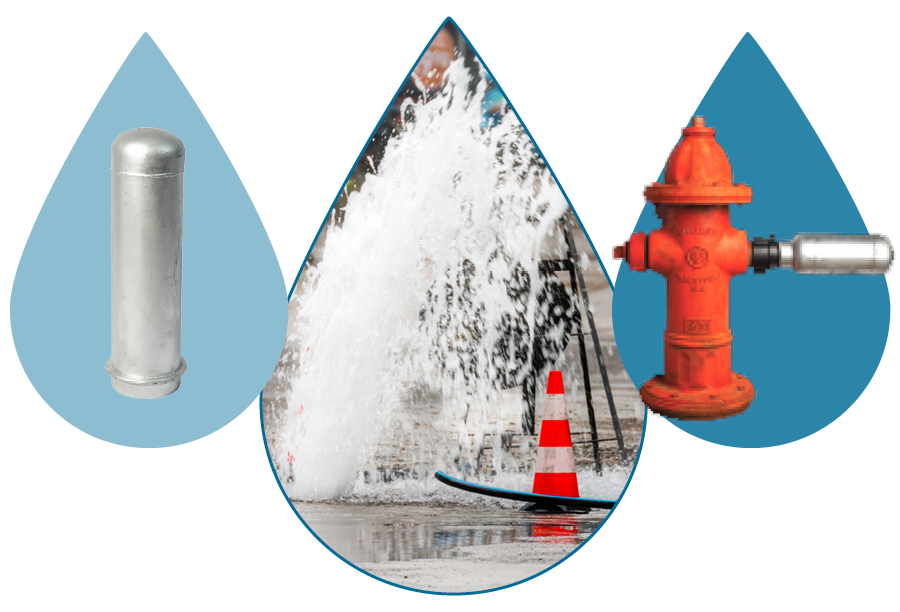
Water under pressure seeks release.
A main break occurs when water is under extreme high pressure and finds release at the weakest point. Weak points can be caused by:
When the water hammer is effectively controlled, pipes can survive most of these conditions for extended periods of time.
Note: Gen 4 has been replaced with improved models made in the U.S.

Absorb the shock and help protect your system.
Elevated water towers can provide a release point but too few water towers exist and they’re often not close enough to the source of water hammer.
What if we could replicate a water tower’s transient-absorbing function within our systems?
Especially in places where we’ve identified weak points?
Long-lasting surge suppression for public water systems.
Heil2O underground surge suppression is designed to mimic the water tower’s transient-absorbing function, allowing water under pressure to move into a vessel. Inside the vessel, compression of air serves as a cushion to calm the water hammer so it no longer seeks release.
Unlike a water tower, underground suppression eliminates problems of stagnation, freezing, cleaning, painting and other maintenance. Our product is corrosion-resistant with no wear parts for unlimited longevity.
Protection needed now more than ever.
Main breaks are costly, time-consuming and dangerous for municipalities and their crew. For residents, the flooding, road closings, water outages and boil orders are highly inconvenient.
Utilities that have installed surge suppressors at various points:
- Provide customers with reliable service and, for well water systems, fewer rusty water complaints
- Save water and achieve better accountability
- Reduce maintenance expenses and delay replacements
In Burr Ridge, Illinois, three cast iron subdivision mains earmarked for replacement due to numerous breaks are still intact today because, beginning in 1992, Burr Ridge had the foresight to protect their mains.
Water is our country’s most valuable resource. Shouldn’t we be applying more innovative but common-sense ways to stop wasting it?
Did You Know…?

To absorb the shock of large amounts of water being pumped from Lake Michigan, the Chicago Water Tower was built in 1869 to house a pipe 138 feet tall and 36 inches in diameter. Because Chicago no longer has elevated tanks, it relies on unusually low operating pressure to combat main breaks. Yet many main breaks continue to disrupt water service and traffic in Chicago.
Did You Know…?
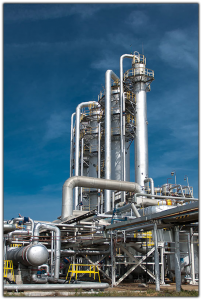
Petroleum pipelines carry nearly 10 times average psi as the water industry and yet they seldom experience breaks. Why? Because they control the outlet of their product and can fine-tune their valves to keep the flow smooth. Water systems need many discharge outlets so we can’t always control valves. But we can help avoid breaks by controlling the water hammer.
Did You Know…?
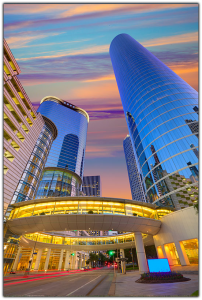
Houston averages only 18 days with temperatures of 32o F or less and yet it experiences more main breaks per mile than any other US city. After surge suppressors were installed in Burr Ridge and other nearby utilities, the cold weather no longer caused an increase in their wintertime breaks.